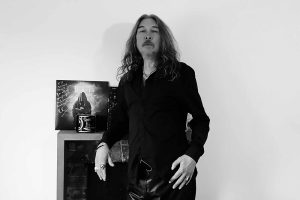
Photo by: Steve Ritchie / Metaltalk.net
Chris Dale is a man who needs no introduction to Iron Maiden fans. In addition to being a part of Bruce Dickinson’s famous band ‘Skunkworks’, Chris is omnipresent and welcome in the wider Iron Maiden and heavy metal community. However, in addition to being a musician and roadie, Chris is also a very successful author of books, and not only about music. I will not go into further introductions to Chris, because in the very first answer to this interview Chris will do it himself.
- It is probably rare for people within the Iron Maiden fan circle who don’t know who Chris Dale is. However, aside from the fact that he is an excellent bassist in Bruce’s band (which is known by a large number of fans), I would dare say that many don’t know that Chris is also an outstanding author, and not just of music-related books. How would you introduce yourself in a LinkedIn-style to those who don’t know you?
Thanks for that nice introduction. Yes, my name’s Chris Dale. I’m a heavy metal bass player, who’s worked with artists such as Bruce Dickinson, Eric Martin and Ricky Gervais, as well as bands such as Tank, Atom Seed and my own project Sack Trick. I’m a backline technician, mostly for pop bands but also sometimes for rock artists such as Mr Big, Glenn Hughes and Armored Saint. I also enjoy writing, and have written books on my experiences in rock and also military history.
- With the book Inside the Skunkworks Machine, you introduced yourself to the fans as an exceptional author, and all we hear from fans about this book are nothing but the best things. Now that you’ve written and published a book, do you think you’ve forgotten something, something you would like to add later, or would you write anything differently? Time flies, album anniversaries keep coming up, so the question arises: do you think there will soon be an anniversary or expanded reissue?
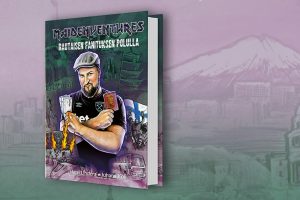
Thank you. Yes, I’ve had such lovely reactions and reviews for ‘Inside the Skunkworks Machine’. That book truly was a labour of love, going back through my memories, scrap books and photo albums but also collaborating on it with so many fans, musicians and friends to make sure all angles of the story were covered. As such, I tried to include every detail of relevance, every cool photo and every funny road story. Inevitably, some anecdotes or photos weren’t included in the book at the time. With the upcoming 30th Anniversary of the Skunkworks album in 2026, I may well re-release the book in a slightly expanded or re-packaged format, though I’ve no firms plans for it at the moment.
- You are known as a bassist who has played on stage with Bruce Dickinson, Paul Di’Anno, and Blaze Bayley. With Bruce, you toured as a musician, and with Paul, you were primarily a carer. It is well known that you stated Bruce, as a businessman and musician, is a completely normal, even ‘boring’ person (this was said in the context of fans’ expectations), and that you could write a short book about a months-long tour with him, while you could write three books about a one-week tour with Paul. Could you try to illustrate this statement with an example?
I think what I actually said was that, two years of playing in a band with Bruce was enough for me to write a book about but two weeks with Paul Di’Anno was enough for a book!
It’s not that Bruce is boring; he’s far from it. He’s very intelligent with a wide knowledge and is a great conversationalist. Rather than boring, I’d say he is reliable. He turns up for shows on time, sings the right words, plays the full gig and has a couple of beers before bedtime. While that does mean that he performs very good concerts, that in itself, isn’t really riveting reading for a book. With Paul however, a typical day might involve him getting into arguments with hotel staff, taxi drivers or drug dealers; hotels would get ruined, dressing rooms were on fire and concerts could be great or absolute chaos changing day by day.
So of course, since Paul’s passing, I have reflected a lot on our times together and yes, I have written the book. It’s innocently titled ‘A Trip To Australia With Paul Di’Anno’ but this is no typical family outing. While ‘666 Days With The Beast’ and its up-coming sequels are Stjepan’s extensive memories of several years with Paul, my book is snap-shot of just two weeks and a deep look into the very complex character that Paul was.
- You edited the book 666 Days With The Beast, about Paul Di’Anno’s life, which was translated from the original Croatian to English with the help of artificial intelligence. As an author, how would you describe the reach of AI today in the world? To what extent was the raw AI text relevant, and what would the book have been like without human intervention?
AI is becoming more and more common in our world and does have many positive sides to it. However, I don’t think writing is one of them right now. I’m sure it will get better but AI made work on that book a bit harder for me. The AI was trying to make phrases more poetic by changing words and not necessarily to ones that described the situation best. One simple example is that at one point I’m sure in the original Croatian text it said “Paul went onstage” but AI decided that “went” wasn’t a very exciting word so changed it to “walked”. And as we all know Paul didn’t walk anywhere in his last few years!
- Tell us something about your other books that are not related to music, but to military history. What are you actually an expert in, what do you write about, and is this expertise based on academic education, or did it develop as a passion for something, leading you to self-specialize in it?
My main field of research is the armed forces of Germany and its colonies before the First World War. I’ve written books and articles for publishers such as Osprey Men At Arms and Zeitschrift für Heereskunde. I’ve also got a couple of self-published books out on Amazon, tracing the histories of all the German infantry and cavalry regiments prior to 1914.
For me, military history has been a passion, since I was very young watching war films on a Saturday afternoon, then wanting to read more and more on the topic. I studied History in high school and planned to study it at university. But then rock and roll got in the way and I became a professional bass player instead. Around twenty years ago, I got back into military history and with the advent of the internet a lot more information became available. I read German, so I was able to go through German sources and archives to find information that wasn’t readily available to English speakers. From there I started a writing a website called GermanColonialUniforms.co.uk which has become highly respected in the community. From there, the books became a natural progression.
- You don’t need to reveal details, if you think it’s not appropriate at this time, but could you at least give us a rough idea of whether you are working on a music project, whether it’s an album, single, or a music-related book?
I must say that I am spending a lot more time on writing history than music right now. I still enjoy playing bass but these days I’m quite happy to play covers of my favourite classic songs (and often a few Bruce or Maiden covers) in clubs rather than strive to create something new. I did recently record an album for the Bosnian author/actor Fedja Stukan, with Alex Elena from the Skunkworks band on drums. Fedja’s a good friend and the music is an eclectic mix of soundscapes which was a fun challenge and a very enjoyable process. That should be out in the next few months. As for books, I’ve got a good one of the German Marine Infantry coming up soon!
- How, in your opinion, has Brexit affected the music industry in the UK, and what solutions are on the horizon?
It’s been really tough, honestly. I know the people who voted for Brexit mostly did so out of a genuine desire to improve our country but all it has done is negative in its effects. It’s hit farmers, fishermen, restaurants, the health service, education, businesses both big and small and of course it has hit the touring music industry hard. Whereas we could once just load up a van with equipment and instruments and freely drive to play as many shows and sell as much merchandise as we wanted all across Europe, now we are allowed only limited time on the continent and have added expensive and time-consuming paperwork. This all makes tours (especially for smaller bands) less financially viable, which means less profits, lower wages for band and crew and in some cases cancellations of shows or entire tours. Britain was once the hub of the touring music industry for Europe but now we see Germany dominating the market.
There are no solutions on the horizon, at least none proposed by our government. The only solution will be a closer alignment with the European Union and eventually re-joining although under much less advantageous terms than we previously had. This is ultimately inevitable if we want British trade and business to succeed, though it may be decades away.
- As an author, are you fast, working in one artistic burst, or do you need a lot of time to create?
I mostly work quite methodically especially with military history but there are times when I have sudden bursts of inspiration and have to write ideas so quickly that they’re full of typing errors. I then later go back and edit them into a readable format.
- You are still working in the music industry, mostly as part of live production. How do you view the scene today? Do you see a possibility that a new heavy name will finally emerge, or does the conversation still revolve around the existing rock and metal legends?
Most of my work in the music industry these days is guitar teching for 1980s pop bands, so I don’t have a lot of connection with the young rock scene. But we’re living in interesting times for sure. All our favourite classic bands have either retired or will retire in the next few years. Of course new bands will replace them on festivals and big shows. As to which bands become the new classics, that’s really not for me to say. I’m an old man who saw Maiden at Hammersmith Odeon in the 1980s. It’s for the next generation to decide who their new favourites will be.
- We are reaching an age where more and more of our peers are passing away, and when it’s not just any people, but those we grew up with, worked with, and spent time with. You recently had the same experience with the passing of Robin Guy, and now Steve Goldby. Both left a significant mark on British rock and metal history. Do you think their importance has been properly recognized, or should more be done to preserve their legacy?
Robin Guy and Steve Goldby were both very close friends of mine. Robin was my best drummer buddy. We worked together on several bands’ concerts and recordings, probably best known to readers here would be Bruce Dickinson’s 2002 European Festival tour. Steve was also a great mate who encouraged my writing on the MetalTalk website, which he founded. If it weren’t for him, I would never have written the ‘Scream For Me Sarajevo’ articles which became the basis of the film of the same name.
Both of these very talented individuals will always be remembered by friends and family but their legacy will live on in their works: the music Robin recorded and Steve’s MetalTalk website which still continues under new management.
- Do you read music books, regardless of which musicians or bands they’re about, and could you name your favourites and explain why those particular books?
Will it surprise you to learn that I mostly read military history?
But yes, I do read rock stories too from time to time. I am a massive KISS fan so I loved the autobiographies that the four original members came out with a few years back. What I enjoyed the most is hearing their four different sides of the same stories, hearing those angles gave a great insight into their characters and mental health. Also on the subject of KISS, there’s an excellent author called Julian Gill, who has written some very in-depth books about individual KISS albums, eras and tours. If you like KISS, he really is worth checking out.
- What is your current greatest life achievement that you are proud of?
Without a doubt, it was the concert that we played with Bruce Dickinson in Sarajevo while the city was under siege in 1994, and the film ‘Scream For Me Sarajevo’ which told its story. Although at the time, I didn’t grasp the full significance of that concert (I was too busy trying not to get shot at) I’ve since realised that that one concert really lifted the spirits of the people of Sarajevo who were enduring such horrors at the time. The film then spread that story of music over-coming the worst times of people’s lives around the world. Again, as we were making the film, I had no idea of the significance of it. I was shocked when we won film awards and got invited to screenings across Europe and even in Hollywood itself. Sarajevo to me now feels like a second home and I feel very humbled by the welcome I receive there these days.
Buy Chris’ Dale book ‘Inside The Skunkworks Machine’ by clicking on this link!
Views: 147